











Why money, deleting and access always wait for you
Nymoru is built to act on its own. Three kinds of action are the exception, and no setting can change that.

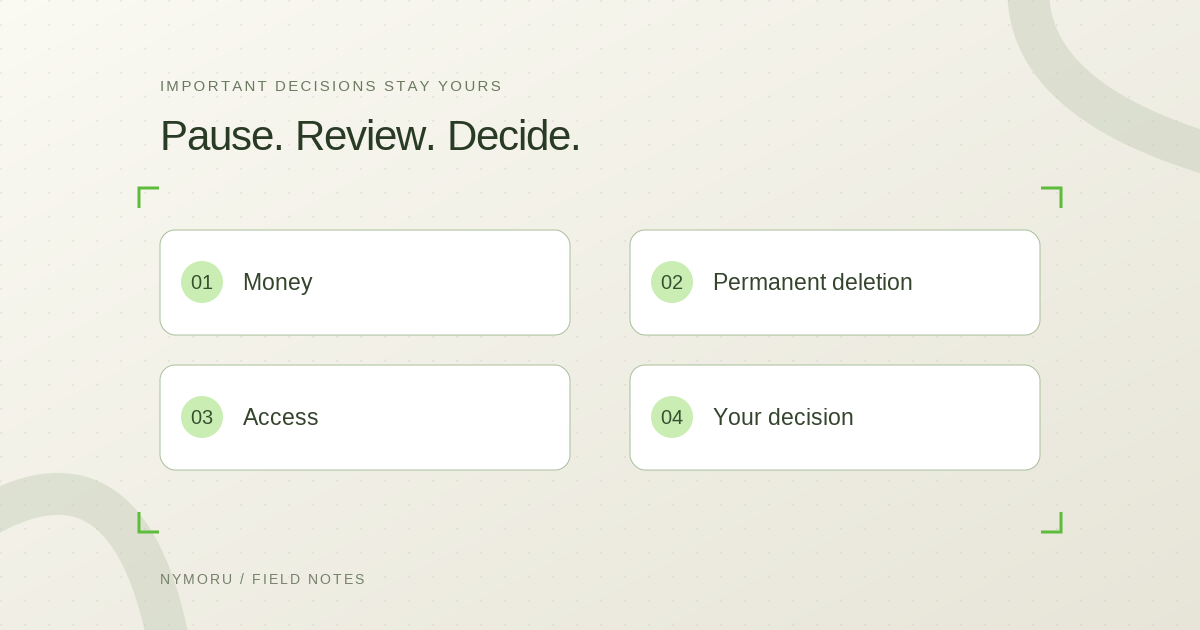
An assistant that asks permission for everything is not much help, and one that asks for nothing is not safe. Nymoru is designed to do the work and keep you informed, and to stop for exactly three things.
The three gates
- Moving money: payments, purchases of any amount and transfers.
- Deleting for good: emptying the trash, permanent deletes, deleting the account, hard deletes in a connected app.
- Granting access: permissions, sharing outside the company and adding admins.
These always need a person’s own tap on screen. A spoken “yes” is not enough, there is no “always allow”, and a company setting cannot remove them. Bots can never empty the trash or delete permanently.
Everything else moves, with a way back
Reading, searching and drafting go ahead. A message to someone outside your company waits 10 seconds with Undo before it leaves; a company can set that window between 5 and 60 seconds. Deleted files, messages, bots, rooms, routines and memories wait in the trash for 30 days.
When content comes from outside
If a bot read outside content in the same turn, such as a web page, an incoming email or data from another app, a write through a connected app needs your tap instead of the undo window. Outside text is treated as data, not as instructions.
Unknown means no
An action Nymoru has no rule for does not go ahead: it waits for a manager’s approval. Every policy decision is written to an audit log; you see yours, and company admins see the company’s.
Companies can add approvals on top: for sends, meetings, writes in connected apps, outside shares and merges or deploys. They can add, never remove.